How to Launch a Shopify DTC Brand on TikTok Shop & Scale With Meta Ads
Why Most DTC Brands Don't Have an Ad Problem — They Have a Growth System Problem
By Sagan Rios — TikTok Shop launch agency USA
Most DTC brands don't have an ad problem — they have a growth system problem. Launch on TikTok Shop first to discover which customer, desire, creator and message actually produce sales, then turn those validated winners into Meta ads and angle-specific Shopify landing pages. Research → creators → UGC → organic TikTok → TikTok Shop sales data → creative variations → paid amplification → post-purchase research → better creative.
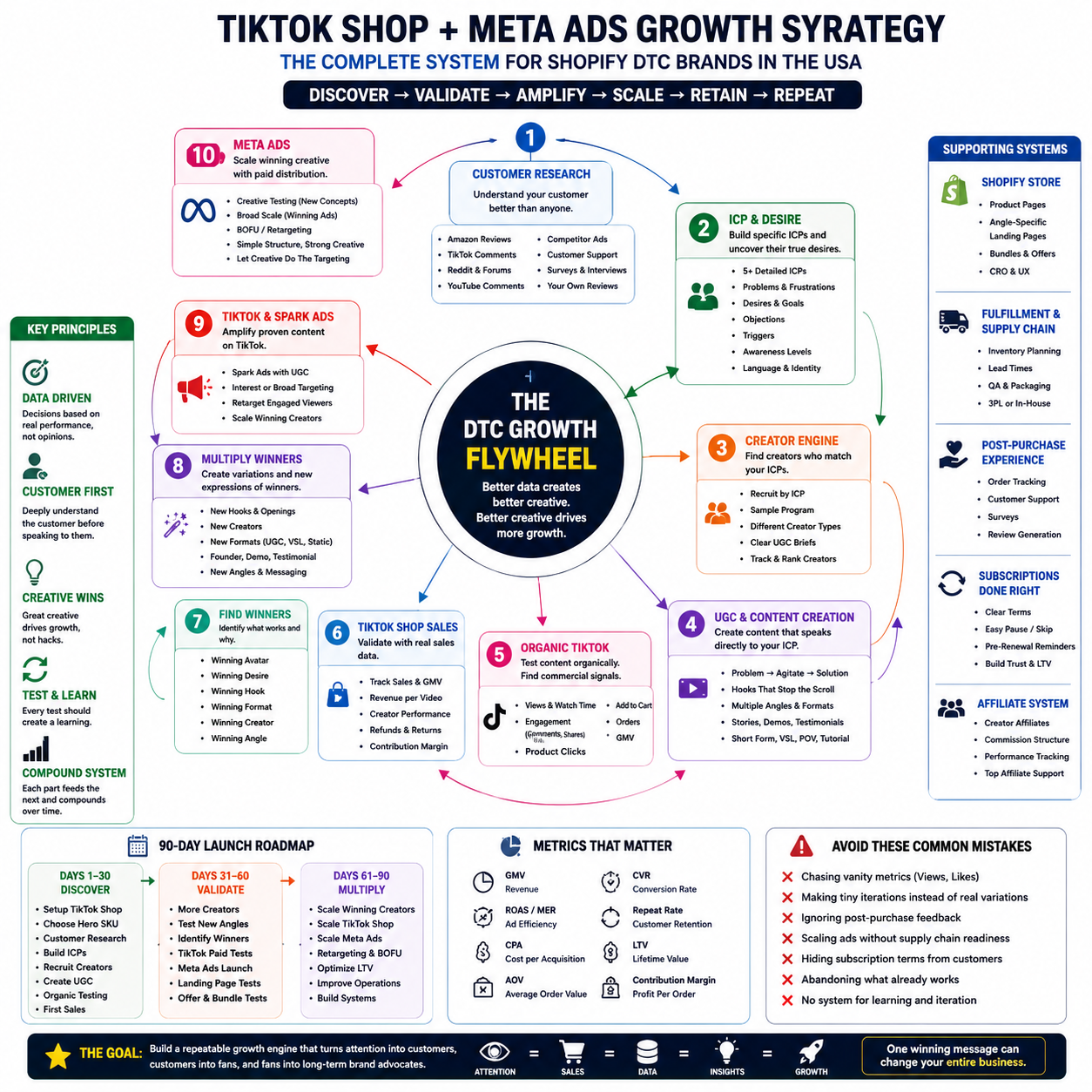
I think one of the biggest traps in ecommerce is assuming every slowdown is an advertising problem. Meta ROAS drops? Change the campaign. CPA goes up? Change the targeting. A winning ad dies? Make another hook. Revenue slows? Increase the discount. TikTok isn't converting? Send more products to creators.
Eventually you end up with a Shopify store running 50 ads, 30 creators waiting for samples, a warehouse trying to figure out inventory, customer service handling subscription complaints, and nobody able to explain what is actually driving profitable growth.
Once you're launching a DTC brand on TikTok Shop in the US — particularly a supplement, beauty, wellness or CPG brand — TikTok Shop isn't just another place to list products. It adds a layer to your entire ecommerce operation. Built correctly, that layer makes your Shopify store, Meta ads, UGC, customer research and retention strategy better.
Your DTC Business Is a System
Shopify, TikTok Shop, Meta Ads, creators and email shouldn't be five separate things. They should operate like one machine, where every part tells the next part what to do.
Problem #1: Meta Keeps Spending Money on the Wrong Ad
You launch several ads, Meta grabs one, and suddenly 70% of spend goes there — without producing enough sales. Inside a CBO, one ad taking most of the budget isn't automatically a problem if campaign economics improve. But if the campaign deteriorates, you need to understand why Meta finds that creative attractive.
Attention ≠ buying intent
An ad can get 500,000 views, thousands of likes, hundreds of comments and cheap clicks — and still be terrible for the business. You created curiosity, not commercial intent.
1,000,000 views. Hilarious. $1,200 GMV.
65,000 views. A boring bathroom selfie about changing her morning routine. $9,000 GMV.
I'm studying Creator B. The purpose of a creative system isn't virality — it's profitable attention. Before throwing thousands behind a viral TikTok, ask two different questions: did people watch it, and did the right people want the product?
Problem #2: You're Stuck in the Creative Iteration Loop
You find a winner — "Why I stopped drinking coffee at 2PM" — so you make "at 3PM," "every afternoon," "why I don't drink afternoon coffee," "why this replaced my second coffee." Forty ads later, you've really made one ad forty times.
Same idea. Different hook, opening, CTA, edit. Useful for optimization — but limited.
Same validated customer and desire, completely different execution: founder story, confession, demo, comparison, VSL, static, street interview, POV, routine, "my husband noticed," educational, myth-busting, before/after, advertorial.
TikTok Shop is perfect for discovering variations
If the winning customer is a busy professional aged 30–45 and the winning desire is consistent afternoon energy, recruit creators inside that world: a founder, a mom, an attorney, a remote worker, a fitness creator, a nurse, a dad, a sales pro, a freelancer, a morning-routine creator. Same desire, ten different stories — and TikTok tells you which interpretation resonates.
Problem #3: Your Winning Ad Didn't Randomly "Die"
Sometimes platform dynamics change. Often the market simply caught up: competitors copied the hook, consumers saw it repeatedly, novelty disappeared. That's market sophistication — as customers see more competing claims, the messaging needed to capture attention has to evolve.
Launching another greens powder promising "daily greens for energy & gut health" puts you in a stadium with 500 brands shouting the same sentence. The answer isn't always to shout louder. Sometimes you need a different conversation.
The mechanism game
When customers already understand the category, explain why your solution works differently. That never means inventing pseudo-science or making unsupported health claims — especially with supplements. It means making your real, defensible difference easy to understand:
- Formulation
- Ingredient sourcing
- Format
- Convenience
- Taste
- Dosage
- Routine
- Manufacturing
- Use case
- Customer type
- Packaging
- Delivery system
Why TikTok Shop Should Come Before Heavy Meta Scaling
Instead of making 20 ads, pushing them to Meta and spending $10,000 to find out what customers care about, I'd rather run the sequence below. TikTok becomes the creative laboratory; Meta becomes the amplifier.
Problem #4: Your Customer Should Be Writing Your Next Ads
The most underused asset in ecommerce shows up after the purchase: the post-purchase survey. Ask customers the same research questions you'd use to develop ads — symptoms, failed solutions, desired outcome, hesitation.
“I was tired of needing coffee before picking my kids up from school.”
There's your next TikTok.
“I've tried three electrolyte brands and they all taste way too salty.”
There's your next Meta hook.
“I almost didn't buy because I thought it was another overpriced wellness product.”
There's your BOFU ad.
My post-purchase research framework
- What problem were you trying to solve when you purchased?
- What had you tried previously?
- What frustrated you about those solutions?
- What result were you hoping to get?
- What almost stopped you from ordering?
- What finally convinced you to purchase?
- How would you describe the product to a friend?
Categorize every response into problems, desires, objections, language, use cases and triggers — then turn them into creator briefs. That's how the loop gets better every month.
Problem #5: Your Supply Chain Is Marketing Too
You hit a winner. TikTok moves, affiliates sell, Meta works. $20K → $50K → $100K. Then you're out of inventory, and your marketing problem is now an operations problem.
When delays happen: communicate early and transparently, give realistic expectations, prepare support, ship older orders first when inventory is partial, and consider reasonable compensation rather than letting frustrated customers discover the problem themselves. And never scale paid media faster than your supply chain can support.
- Daily unit capacity
- Weeks of stock
- Manufacturing lead time
- Freight time
- Safety stock
- Creator sample inventory
- Paid-media inventory
- Expected reorder date
Be careful with fake urgency
Don't use a fake or already-passed preorder date to manufacture urgency. Communicate the real shipping window and update promptly if it changes. Legitimate urgency still works — first production batch nearly allocated, limited quantity, offer ends Sunday, next batch ships September 10 — but only when it's true. Trust is worth far more than a temporary CVR bump.
Problem #6: Subscription Revenue Can Become a Chargeback Machine
Subscriptions are incredible for LTV, until brands chase take-rate so hard the terms become confusing. Don't trick people into LTV — earn it.
Subscribe & save with clear price, frequency, savings, what's included and how pause/cancel works.
Clearly identify recurring purchase terms.
Confirm the subscription: next shipment, next billing, account management.
Send a reminder before the charge.
Skip, pause, cancel, change frequency.
Give customers actual reasons to stay.
Subscription and negative-option laws vary and evolve — have qualified counsel review your actual implementation.
How I'd Launch a Shopify Brand on TikTok Shop
Imagine a DTC supplement or CPG brand doing $30K/month on Shopify, with inconsistent Meta performance, that wants TikTok Shop. Here's the sequence I'd run.
- Connect Shopify and TikTok Shop
- Prepare listings
- Choose hero SKU
- Check margins
- Calculate break-even CPA
- Understand inventory
- Map fulfillment
- Build post-purchase survey
- Build creator tracking
- 100+ reviews
- TikTok comments
- Reddit conversations
- Competitor ads
- Support tickets
- Survey responses
- Build 5 ICPs with problem, desire, failed solution, objection, trigger, awareness level and hook bank
- A controlled cohort — not 500 free samples
- ~30 creators
- Different ICPs
- Different formats
- Different angles
- Different creator archetypes
- Track everything
- Founder content
- Creator UGC
- Problem/solution
- Educational
- Demonstration
- Comparison
- Routine
- Testimonials where appropriate
- Look for commercial signals, not virality
- Views
- Product clicks
- CTR
- Add-to-cart
- Orders
- GMV
- Creator revenue
- Revenue per video
- Refunds
- Contribution margin
- Which avatar won?
- Which desire won?
- Build substantially different executions
- Escape the iteration loop
- Creative testing: new validated concepts
- Broad scale: proven ads
- BOFU: reviews, testimonials, FAQs, comparison, objections, offers
- Same problem
- Same customer
- Same promise
- Same product
- Same creator proof
- The ad continues the conversation instead of dumping traffic on a homepage
- What sold?
- Who bought and why?
- Which creator, hook and desire won?
- Which objection appeared?
- Which Meta creative scaled?
- Which landing page converted?
- Brief next week from the answers
My 90-Day TikTok Shop + Meta DTC Launch Framework
- Shopify → TikTok Shop
- Hero SKU
- Research
- ICPs
- 30 creators
- UGC
- Organic
- Customer survey
- Initial sales
- Winning ICPs
- Winning desires
- Winning creators
- Winning formats
- Paid TikTok testing
- Creative variations
- Meta launch
- Landing-page testing
- More winning creators
- More validated angles
- TikTok paid amplification
- Meta broad scale
- BOFU
- Bundles
- Subscription optimization
- LTV
- Inventory planning
- Post-purchase research
The Entire System in One Framework
The Point Isn't TikTok Shop
TikTok Shop isn't the strategy. Meta isn't the strategy. Shopify isn't the strategy. UGC isn't the strategy. The feedback loop is the strategy. Every customer, creator, video, ad and purchase teaches you something — and brands that convert those lessons into the next generation of creative faster than competitors become extremely hard to beat.
So if I were launching a Shopify brand onto TikTok Shop in the USA today, the question wouldn't be "how many ads can we make?" It would be "how quickly can we figure out exactly what makes this customer buy — and build a system that keeps discovering the next answer?"
Want this growth system built for your Shopify brand?
Book a strategy call and we'll map what the first 90 days of your US TikTok Shop launch could look like — hero SKU, ICPs, creator cohort, UGC plan and the Meta amplification path.
Book a free TikTok Shop strategy call →TikTok Shop Launch for Shopify Brands: FAQ
What is a TikTok Shop launch for Shopify brands?
It's connecting your existing Shopify catalog to TikTok Shop and running a creator-led discovery system on top of it — customer research, ICPs, UGC, organic posting and TikTok Shop sales data — so you learn what makes people buy before scaling Meta ads.
Should I launch TikTok Shop before scaling Meta ads?
Yes, in most cases. TikTok Shop is a cheap creative laboratory where creators produce dozens of angles and real purchase data tells you which message carries commercial intent. Meta then becomes the amplifier for concepts that already have evidence behind them.
Why did my winning Meta ad suddenly stop working?
Often the market caught up. Competitors copied the hook, consumers saw it repeatedly and the novelty faded. That's market sophistication, not a targeting bug. The fix is a genuinely different conversation — a mechanism, format or avatar shift — not another tiny iteration.
What's the difference between an iteration and a variation?
An iteration keeps the same idea and changes the hook, opening or edit. A variation keeps the validated customer and desire but changes the execution entirely: founder story, demo, comparison, VSL, street interview, POV, advertorial. Variations expand your creative surface area; iterations exhaust it.
How many creators should a Shopify brand start with on TikTok Shop?
Start with a controlled cohort of roughly 30 creators spread across different ICPs, formats and archetypes — small enough that you can track delivery, posting, clicks, GMV and revenue per video, and actually learn from the results.
How do I avoid TikTok Shop demand outrunning my supply chain?
Know your daily unit capacity, weeks of stock, manufacturing lead time, freight time, safety stock and creator sample inventory before you scale. Never scale paid media faster than fulfillment can support, and communicate real shipping windows instead of manufacturing fake urgency.
How should DTC supplement brands structure subscriptions?
Clearly label subscribe-and-save, show recurring price and frequency, explain pause and cancellation, offer a one-time option, remind customers before renewal and give a self-serve portal. Earn LTV — don't trap people into it. Have qualified counsel review your implementation.